| |
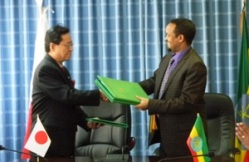
On 25 December, 2012, a signing ceremony for an Exchange of Notes for grant-in-aid for a food security program for underprivileged farmers, better known as KR II, took place between the governments of Japan and Ethiopia, represented by His Excellency Hiroyuki Kishino, Ambassador of Japan to Ethiopia and H.E. Ato Ahmed Shide, State Minister of Finance and Economic Development, respectively. The amount of the grant is 490 million Japanese Yen [equivalent to 105 million ETB at the current exchange rate]. This assistance aims to help Ethiopia promote food production with the supply of agricultural inputs.
Speaking at the ceremony, H.E. Ambassador Hiroyuki Kishino explained that Japan had extended the grant-in-aid as part of its support to the Growth and Transformation Plan (GTP), which has set a projected average annual growth rate for agriculture of 8.6% for five years from 2010/11. To achieve this target, modern agricultural inputs are important, in particular fertilizer, which has been identified as a priority area in the 10-year Agricultural Sector Policy and Investment Framework (PIF) Program that was adopted in August 2010.
H.E. Ambassador Kishino continued by saying that data shows that the annual fertilizer requirement has gone up substantially in Ethiopia, reaching 1.75 million tons in 2011. This will require Ethiopia to spend additional foreign reserves for fertilizer imports due to its limited domestic supply capacity. Therefore, Japan is pleased to play a modest role in mitigating the existing supply-demand gap of fertilizer through its Grant-in-aid Scheme, KR II. To date, the total amount Japan has provided to Ethiopia through KR II since 1985 amounts to 16.1 billion Japanese Yen [equivalent to 3.46 billion ETB at the current exchange rate].
Japan has been engaged with the economic and social development of Ethiopia for many years and modified its ODA policy this year to better help Ethiopia implement the GTP. Given its dominant role in the Ethiopian economy, agriculture is one of the priority areas of the GTP. As of 2010, 77% of the population is engaged with agriculture, and about 41% of the GDP is created by agriculture. Thus, food security, which includes agricultural and rural development as well as water supply, is one of the two main pillars of Japan’s new ODA policy in Ethiopia together with industrial development.
| |